
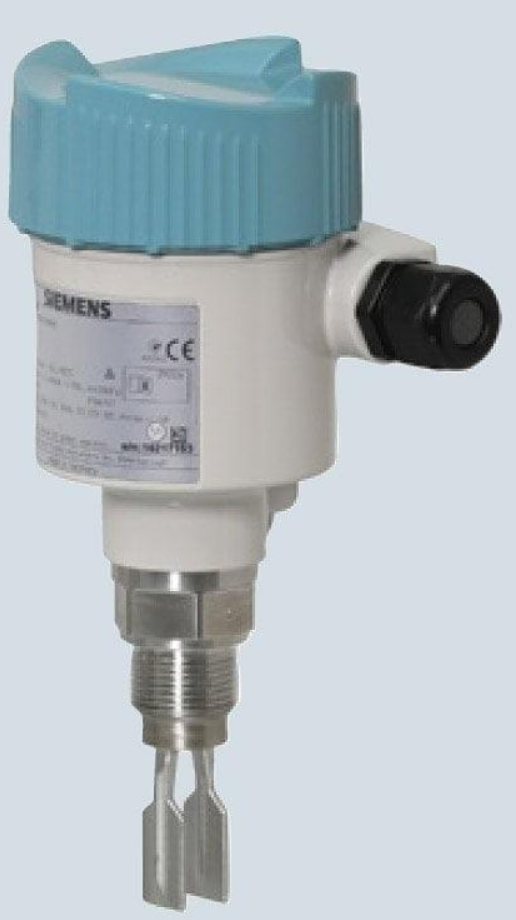
Product overview
The Siemens SITRANS LVL200 is a vibrating-fork level switch for detecting high, low or demand levels in liquids and slurries. It is commonly used for overfill alarms, dry-running protection and automatic pump control.
The sensor is unaffected by changes in conductivity, dielectric constant, vapour, gas, foam or bubbles, providing reliable switching under difficult process conditions.
Key features
- Reliable point-level detection
- Suitable for liquids and slurries
- Compact 40 mm insertion length
- High-level and low-level alarm operation
- Pump dry-running protection
- No calibration normally required
- No moving mechanical components
- Fault monitoring for corrosion, vibration loss and cable failure
- SIL 2 functional-safety versions
- Hazardous-area configurations
- High-temperature and high-pressure options
- Hygienic process connections available
- Suitable for API 2350 overfill applications
Technical specifications
| Parameter | Specification |
|---|---|
| Measuring principle | Vibrating-fork point level detection |
| Detection functions | High, low and demand level |
| Standard insertion length | Approximately 40 mm |
| Repeatability | Approximately 0.1 mm |
| Standard process temperature | Configuration dependent |
| Extended temperature options | Up to approximately 250°C |
| Special high-temperature versions | Up to 450°C |
| Standard pressure options | Up to approximately 64 bar |
| Special pressure versions | Up to 100 or 160 bar |
| Output options | DPDT relay, NAMUR, transistor or 8/16 mA |
| Transistor supply | 10–55 V DC |
| Protection rating | IP66/IP67, NEMA 4X |
| Process connections | BSP, NPT, flange or hygienic fitting |
| Wetted material | Stainless steel; coated options available |
| Safety certification | SIL 2 options |
| Hazardous-area approvals | ATEX, IECEx, FM and CSA options |
Temperature and pressure ratings depend on the selected process connection, sealing system and product configuration.
Marine and industrial applications
- Fuel and lubricating-oil tanks
- Hydraulic-oil reservoirs
- Freshwater and ballast tanks
- Sludge and wastewater tanks
- Chemical-storage vessels
- Boiler-water systems
- Pump dry-running protection
- Tank overfill prevention
- Separator and process skids
- Offshore production equipment
- LNG and LPG auxiliary systems when appropriately certified
